

The Three Fields of Gravity
A mental model of influence


Gravity is one of the few forces that is everywhere at all times, and yet, we often don’t consciously notice it. Without it, the universe would literally pull apart at the seams. It’s the glue that holds the cosmos together and creates the elegant balance in our galaxy. Life itself would cease to exist without gravity. It pulls the oceans and atmosphere down to our home on Earth. The water needed for life would float away, and the air we need to breathe would disappear into the cold vacuum of space. Gravity is a miracle.
Ironically, it can also be lethal if ignored. Ask anyone who has misjudged a step on a steep staircase. You can’t argue with physics, and you certainly can’t argue with the pavement. The danger isn’t always this obvious, which is why it is worth noting how gravity shows up in more subtle ways that can adversely affect us. This is the kind of gravity that isn’t defined by physics, but by psychology. It’s a force that can make your life a lot easier or a lot harder depending on your ability to identify it.
To navigate this invisible psychology, we must map its coordinates. This is the foundation of the framework I call The Three Fields of Gravity, which breaks down the major areas of life where you may be influenced without knowing it: Self-Gravity, Social-Gravity, and Systemic-Gravity. Each of these pillars overlaps in a three-way Venn diagram, and every person exists at the very center of this model.
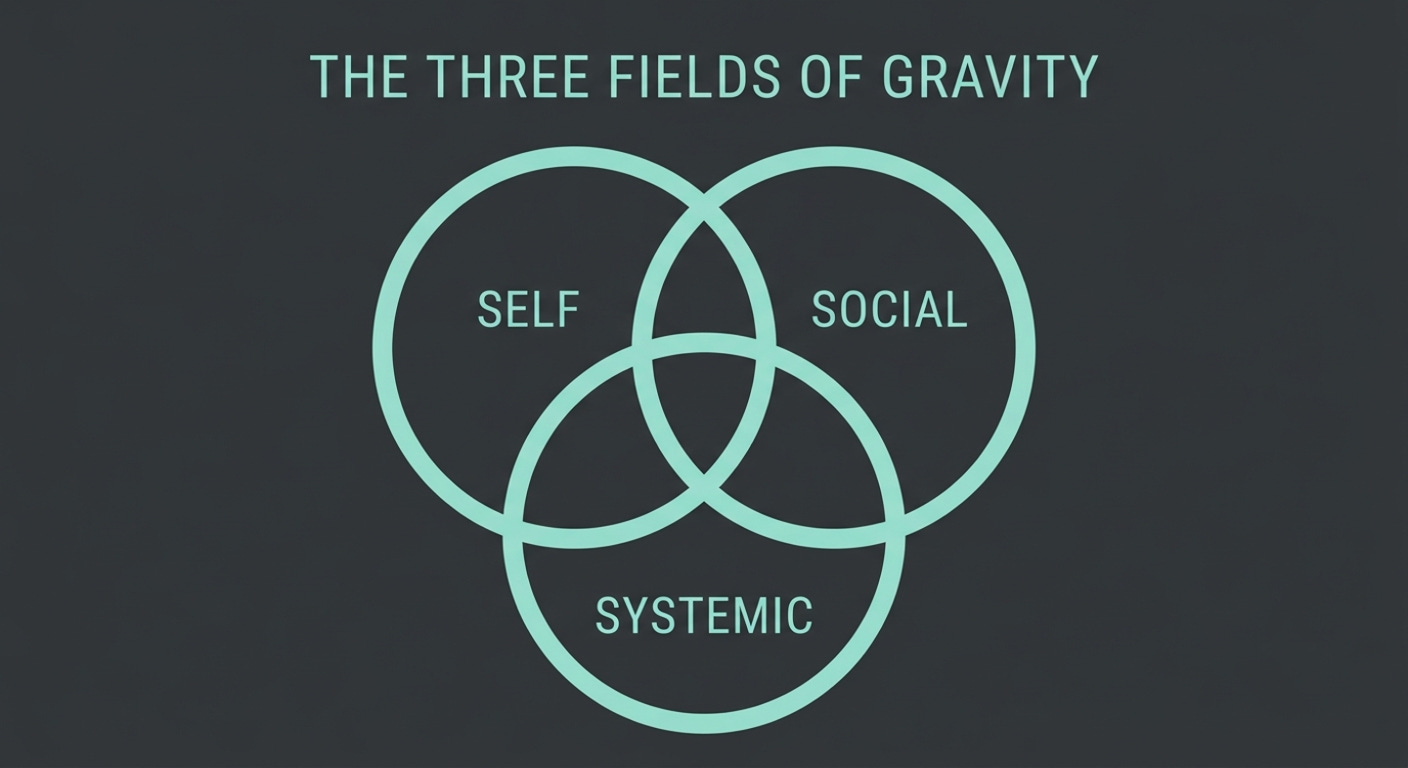
Here is how each of these forces shows up in your daily life.
Self-Gravity
Self-Gravity is the most intimate of the three fields. It is also one of the hardest to spot, because we are incredibly skilled at convincing ourselves of whatever we must to protect our fragile egos.
It is the comfort zone that keeps us in a miserable job; the procrastination we disguise as perfectionism; and the self-sabotage we inflict to avoid a life we don’t believe we deserve. It is the invisible hand of your own psychology pulling you backward.
These are all excuses. Fear dressed up as reason.
This may very well be the most difficult form of gravity one can experience, because it requires you to look at yourself honestly and objectively.
Social-Gravity
Social-Gravity is usually a term we apply to networking, but I’m repurposing it for this framework. This form of influence is defined by the people who are closest to you. A popular Jim Rohn quote comes to mind:
“You are the average of the five people you spend the most time with.”
Do you surround yourself with people who champion your ideas and abilities, or people who secretly prey on your downfall?
Sometimes, the threat isn’t active malice, but well-meaning expectations. Those around us mean well, but the weight of their expectations can be too heavy for us to carry. They may envision a different future for you than the one you see for yourself. Other times, you might be met with a complete rejection of the path you want. Setting proper boundaries is the only way to deal with disruptive Social-Gravity.
Systemic-Gravity
Systemic-Gravity is a broad field of influence that applies heavily to modern life. There is no shortage of noise in the 21st century, and the rapid pace of technological change is a major driver of this. Social media feeds designed to capture your attention, complex algorithms keeping you scrolling, and the rapid evolution of artificial intelligence make it hard to focus on any single objective for long.
While technology is a massive component of this field, it also applies to our institutions. Your school, place of work, and even your political bodies create a strong cultural undertow that quietly shapes your behavior over time.
The Anatomy of Drift
Gravity is a morally neutral force; it isn’t inherently good or bad. It simply does what it always does: it pulls whatever is caught in its field.
The point of this framework is to identify the largest sources of influence in your life. When you’ve done this successfully, it is much easier to choose a deliberate course of action. Many things can derail us from our purpose and steer us off course. That’s why I call this phenomenon drift. It’s hard to know that you’re moving in the wrong direction when you think you’re the only one steering.
The most natural place to start is to look at your own Self-Gravity. Ideas have weight, and with weight comes pull. It’s crucial that you pay close attention to which ideas you give weight. Take a look at some of the things you believe or tell yourself daily. If you think you aren’t capable of something, you likely won’t be. Henry Ford put it best:
“Whether you think you can, or you think you can’t – you’re right.”
The more weight you give an idea, the stronger its pull on your behavior.
If you truly believe you are meant to do something with your life (whether that is to write, design, or build), the weight of that belief will pull you more than any external force. What you choose to believe about yourself is the strongest weapon you have against drift.
Subscribe to Enter Gravity
Essay every Tuesday